
Alt Text
May 22, 2026LSI Keywords
May 25, 2026Anchor Text
Anchor text is the clickable, visible text of a hyperlink that connects one web page to another.
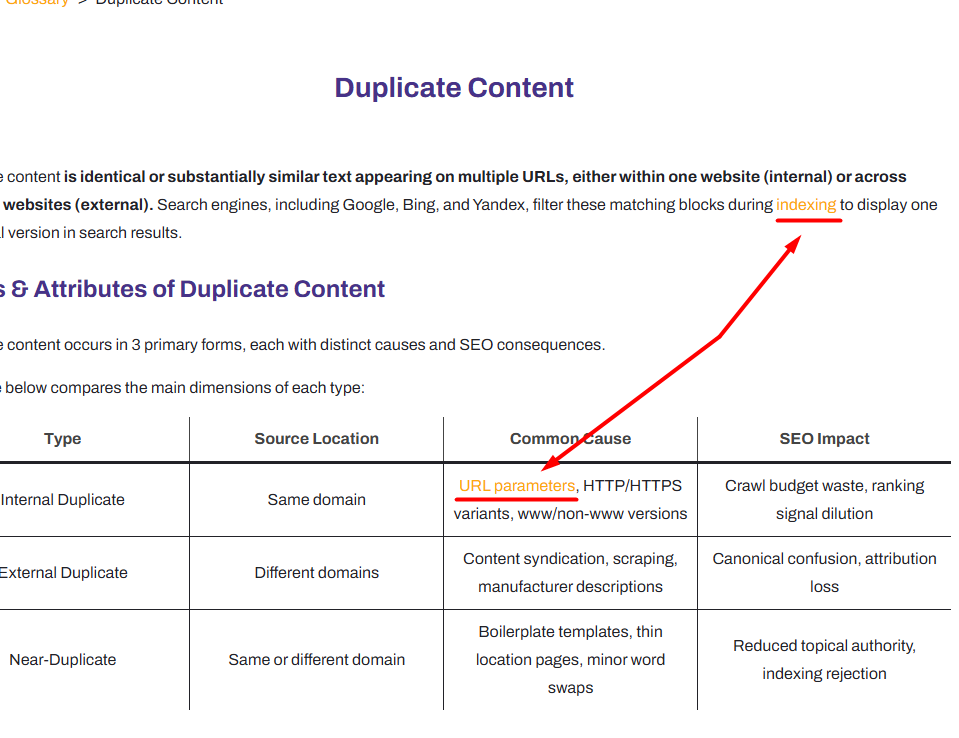
Search engines use this text to interpret the topic of the destination page, while users rely on it to predict the content behind the link.
Anchor text functions as a contextual label for a hyperlink. The HTML structure wraps a word or phrase inside a <a> tag, which contains the destination URL. The visible text inside the tag forms the anchor text. Google, Bing, and other search engines analyze anchor text to determine relevance signals between the source page and the linked page.
Types of Anchor Text
There are 6 main types of anchor text, each carrying a distinct function in semantic SEO.
| Anchor Text Type | Definition | Example | Primary Function |
|---|---|---|---|
| Exact Match | Contains the precise target keyword | “anchor text” | Signals direct topical relevance |
| Partial Match | Contains a variation of the keyword | “types of anchor text” | Expands semantic coverage |
| Branded | Uses a company or product name | “HubSpot” | Builds brand entity association |
| Generic | Uses non-descriptive phrases | “click here” | Provides navigational cues |
| Naked URL | Displays the raw URL as text | “https://example.com” | Indicates direct source citation |
| Image | Uses an image’s alt attribute as the link | Alt: “SEO guide infographic” | Transfers relevance through images |
Why Anchor Text Matters for SEO
Anchor text transfers topical relevance from the source page to the destination page. Search engines compare the anchor text against the title of the targeted page to verify content alignment. Matching anchor text with the target page title increases the ranking signal strength of the link.
Anchor text influences 3 ranking factors:
- Determines the contextual relevance of the linked page
- Distributes link equity across internal pages
- Reinforces entity associations within a topical cluster
Examples of Anchor Text in Practice
A blog post about digital marketing links to a guide titled “Beginner’s Guide to SEO.” The correct anchor text reads “Beginner’s Guide to SEO” rather than “click here.” This matching pattern signals topical consistency.
E-commerce product pages link to category pages using anchor text such as “running shoes,” “trail running shoes,” and “marathon shoes.” Each variation reinforces the parent category through partial-match anchors.
Best Practices for Anchor Text Optimization
Follow these 4 rules to optimize anchor text effectively:
- Match the anchor text with the targeted page title
- Vary anchor text types across the domain to maintain a natural link profile
- Place anchor text within contextually related sentences
- Avoid over-optimization through repetitive exact-match anchors, if the link profile shows uniform patterns
Anchor text serves as a precise communication channel between the source page, the destination page, and the search engine, provided the wording aligns with the target page’s primary topic.